


Embroidering a New Constitution for Chile: The Textile Artists of the Salvador Allende Solidarity Museum
- Lucia Huerta Torres
- Hugo Rojas Corral
- Lieta Vivaldi Macho
-
Keywords:
- Textile arts
- Human rights
- Constitutional processes
- Chile
-
Palabras clave:
- Arte textil
- Derechos humanos
- Procesos constituyentes
- Chile
1 Introduction
Various attempts have been made to replace Chile’s 1980 Political Constitution, approved during the civil-military dictatorship (1973–1990) in a plebiscite without sufficient electoral guarantees (Fuentes, 2013). Despite the restoration of democracy in 1990 and reforms to the original document, the fundamentals of the country’s socioeconomic model, guaranteed rights, and the state’s organization have persisted (Atria et al., 2013). Constitutional reform efforts have evolved from proposals by President Michelle Bachelet to drafts by elected bodies following the 2019 social mobilizations. During and after the mobilizations, nationwide debates, workshops, and discussions focused on establishing foundations for a more just and supportive Chile.
Since artistic expressions have been present in recent constitutional debates, we aim to explain the current use of textiles in the search for meaningful constitutional changes in transitional Chile. The case study is centered on the experience of the textileras (textile artists) from the Museo de la Solidaridad Salvador Allende (Salvador Allende Solidarity Museum, SASM). Their project was created in 2020 during the COVID-19 pandemic in the workshop Dreaming a New Constitution, offered through Zoom in collaboration with the museum. These virtual encounters, which later materialized in a Textile Constitution, were a moment of companionship and solidarity. In the context of isolation due to the pandemic, creating in community was transformative, both individually and collectively.
This study adopts a qualitative research design (Denzin & Lincoln, 2012), combining documentary analysis with field-based methods. Empirical materials include a semi-structured Zoom interview with two SASM textileras, participant observation in workshop settings, and a discussion forum. Documentary sources comprised materials from the SASM website, press and social media coverage, the Textile Artists’ Manifesto, and the two volumes of the New Textile Constitution. All participants provided informed consent and authorized our presence in their workshops. The discussion forum The Constitutional Proposal of the Textile Artists of the Salvador Allende Solidarity Museum (March 19, 2024, Alberto Hurtado University) was conceived both as a dialogic research space and a site of collective reflection on the constitutional, artistic, and political dimensions of their work. Interview transcripts and fieldnotes from workshops and the forum were subsequently reviewed and comparatively coded in internal analysis sessions to identify recurring themes, convergences, and tensions across sources.
Lucia Huerta met the textile artists by participating in a workshop at the Gabriela Mistral Cultural Centre (GAM) during the second semester of 2023 and participated in four of their weekly meetings1. The Constitutional Nucleus of Alberto Hurtado University, committed to public service, actively engaged in the 2021–2022 and 2023 constitutional processes. Lieta Vivaldi directed the research line on gender in the Constitutional Nucleus and actively participated in councils, workshops, and the development of information for the process. Hugo Rojas collaborated as a volunteer on the systematization of public audiences at the Constitutional Convention’s Human Rights Commission in August and September of 2021 and organized the forum The Constitutional Proposal of the Textile Artists of the Salvador Allende Solidarity Museum.
In the first part of this article, we explain how art has historically functioned as a profound language of resistance and defense of human rights. In authoritarian contexts, it disrupts official narratives and reconfigures the sensible, exposing structures of violence while affirming human dignity. Beyond representation, art constitutes an emancipatory practice that transforms memory and community. From Chilean arpilleras to contemporary muralism, it operates as a living repertoire of justice, sensibility, and knowledge, where aesthetics and politics converge in the pursuit of social transformation.
The second part explains how the Chilean arpillera emerged as a vernacular art form that transformed domestic labor into political testimony. Originating in mid-twentieth-century rural communities, it gained prominence under Augusto Pinochet’s dictatorship, when women used stitching as both livelihood and resistance. Through collective workshops, arpilleristas crafted tactile archives of grief and protest, denouncing state violence and asserting female agency. Circulating globally, these textiles became transnational symbols of solidarity, weaving memory, care, and critique into an enduring language of human rights and resistance.
In the third part, we explore the failures of Chile’s constitutional processes (2021–2022 and 2023), where voters rejected the proposals of the Convention and Constitutional Council, therefore maintaining the 1980 Constitution. Social fatigue from the constitutional debate suggests that there will not be significant changes in the short term, complicating the future if no agreement is made on key points.
In the fourth part, we focus on the work of around 602 people who participated in the workshop Dreaming a New Constitution organized by the SASM textile artists. They created textiles about topics and matters they considered should be portrayed in Chile’s new Constitutional document. The collective product was a «textile book» exhibited around Santiago, and its digital version is available online. The New Textile Constitution promotes textiles as a vehicle of memory and social change, collectively analyzing, challenging, and reimagining the current Constitution.
In the fifth section, we discuss and analyze the relevance of textile art in Chile’s political history, how the New Textile Constitution was created and later impacted by the pandemic, and how this project could continue virtually. In the final part, we synthesize the most important findings and contributions.
2 Art, Resistance, and Human Rights
Art has long stood as one of the most potent languages of resistance. Across history, it has operated as a form of political expression, a tool for the defense of human rights, and a vessel of memory and denunciation. In authoritarian settings, where freedom is curtailed and violence becomes institutionalized, art assumes a subversive role: it interrupts official narratives and reclaims the spaces of dissent. Its power lies not solely in direct confrontation but in the subtle insurgency of imagination, sensitivity, and symbolic creation.
Modern history offers eloquent testimony to this capacity. For example, under Pinochet’s dictatorship in Chile, pervasive censorship could not extinguish the creative spirit of those who sustained a popular culture of resistance within and beyond national borders (Rojas & Shaftoe, 2022, pp. 127–129). These histories reveal that even when totalitarian regimes attempt to impose a monolithic aesthetic, artistic expression resurfaces from the margins, contesting cultural homogenization and safeguarding the autonomy of thought (Preda, 2017, p. 3). As critical theorists have noticed, resistance is not a singular or oppositional gesture but a relational practice embedded in everyday life (Butler, 1997; Foucault, 1978). Resistance is, thus, a complementary and reciprocal term to power. In The History of Sexuality: Volume I, Michel Foucault claims: «Where there is power, there is resistance, and yet, or rather consequently, this resistance is never in a position of exteriority in relation to power» (1978, p. 95). The passage highlights the reciprocal and codetermining relation of power and resistance: resistance is not something outside power but rather intrinsic to it. A relation between the two in which one is at the complete disposal of the other, where there is no resistance whatsoever to the violence of the other, is not a power relation. Within the arts, resistance operates through both confrontation and re-signification, challenging the symbolic orders that sustain domination. Artistic resistance thus unfolds as a performative process: one that reconfigures the sensible and makes visible the unrecognized (Rancière, 2004).
Artistic practice constitutes a political field not simply because it represents injustice but because it produces forms of knowledge, memory, and presence that challenge regimes of erasure. We approach art as praxis: a situated form of agency through which historically marginalized subjects render violence legible and reconstitute fractured collective identities (Barreto, 2020; De Greiff, 2014; Kerr, 2023; Sleeter, 2014). Artistic creation operates across epistemic, affective, and political registers, making visible what hegemonic narratives disavow while enabling communities to narrate themselves as political subjects. This dual process of exposing violence and reassembling social bonds is especially significant in repressive contexts, where art becomes a means of reclaiming presence and public voice.
To understand how these processes unfold, we draw on feminist theory associated with the so-called affective turn, particularly Sara Ahmed’s conceptualization of emotions as relational and circulatory forces rather than interior states (Ahmed, 2004). Ahmed’s notion of «affective economies» is analytically useful because it explains how feelings such as grief, anger, or indignation do political work: they bind subjects together, orient bodies toward or away from institutions, and help constitute collectivities. Affects, in this view, are not inherently emancipatory or oppressive; their political valence depends on how they circulate and become attached to bodies, objects, and narratives. This framework allows us to analyze artistic practices not merely as representations of suffering but as sites where emotions are mobilized, shared, and transformed into collective orientations and political claims.
This perspective is especially productive for examining embodied and material artistic practices, where memory and resistance are enacted through the body and through tactile forms of making. As Diana Taylor (2003) argues, political memory exceeds the archive and persists in the repertoire: embodied, repeatable practices that transmit knowledge and affect across time. While performance art offers a visible example of this dynamic, as seen in feminist actions such as Un violador en tu camino by Las Tesis—featuring black blindfolds referencing the eye injuries inflicted by police during the 2019 demonstrations and squatting gestures evoking arrest positions—which became a global feminist act of embodied protest (Hinsliff, 2020; Serafini, 2018, 2020), similar logics operate in less spectacular yet equally powerful forms of artistic production.
This is where the work of the SASM textile artists becomes analytically central. Their textile practices can be understood as a form of affective and political repertoire: through stitching, weaving, and collective making, they materialize memories of violence, loss, and resistance while simultaneously generating spaces of care, healing, and political articulation. The textile object is not only an aesthetic artifact but a condensation of circulating affects—grief, solidarity, anger, hope—that links individual experience to collective history. By situating these practices within an affective economy, we can see how the artists’ work does more than represent past trauma: it reorganizes social relations in the present, forging communities of memory and positioning participants as political subjects. Artistic practice thus emerges, in this case, as a material, embodied, and affectively charged mode of social transformation.
In the wake of the social movements of the 1960s, politically engaged art took on an unprecedented significance, intertwining creative practice with collective demands and local struggles (Helguera, 2011). Art evolved into a language of civic participation and social critique. In contexts marked by state violence, aesthetic spaces have allowed survivors to narrate trauma, reconstitute memory, and break the silence imposed by power (Jalušič et al., 2019). As Andrea Giunta (2020) reminds us, politically engaged art in Latin America has consistently challenged the hierarchies of the global art canon, positioning the periphery not as derivative but as a site of epistemic and aesthetic innovation. Such practices transform artistic production into a language of civic participation and critical imagination that redefines the boundaries between aesthetics and politics.
Art also possesses a distinct affective power: it shapes collective emotion and fosters empathy. In doing so, it contributes to the reconfiguration of cultural sensibilities. In such instances, art and human rights act in mutual reinforcement, especially within processes of transitional justice. As Pablo De Greiff (2014) observes, interventions across media, literature, and film cultivate forms of social sensibility that can later crystallize into institutional practices and rights.
In educational contexts, integrating art into pedagogical practice has proven to be a powerful means of cultivating empathy and critical reflection (Harz et al., 2023; Zazulak et al., 2015). Artistic engagement awakens dormant consciousness, unsettles indifference, and renders the magnitude of injustice perceptible. Its potency resides in its refusal to dictate truth; instead, it invites reflection, feeling, and action. For this reason, art not only shapes political imagination but also influences social practice, inspiring ethical and emotional responses to conflict and exclusion (Debes, 2017; Edelman, 1995, p. 5; Tiedemann, 2020).
Drawing on feminist theory, affect studies, and situated epistemologies, several scholars have emphasized that dignity is not only a juridical status but something enacted through embodied practices of care, representation, and mutual recognition (Ahmed, 2004; Giunta, 2020; Pérez-Bustos, 2016). These perspectives highlight how recognition emerges relationally through practices that sustain visibility, interdependence, and shared vulnerability, particularly in contexts marked by inequality and exclusion. From this standpoint, art can function as a means of sustaining dignity where institutional justice remains limited or uneven. Artistic practices create spaces in which subjects historically subjected to marginalization can appear, be acknowledged, and be related to as bearers of value and voice.
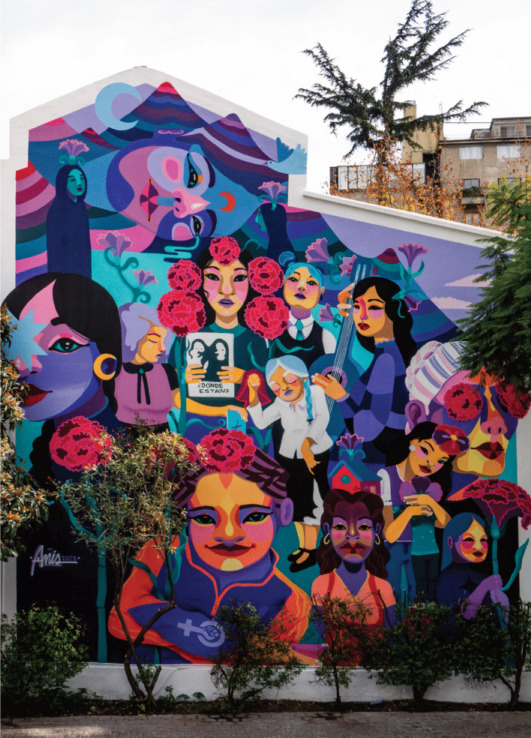
The mural Rosa de los Vientos (2023), created by the Chilean artist Anis and commissioned by the National Institute of Human Rights, illustrates this dynamic. By celebrating the diversity of women and girls who defend human rights across the life course (see Figure 1), the work does more than commemorate resistance: it stages recognition. Such artworks participate in processes of symbolic reparation by re-inscribing marginalized subjects into the public visual field and by contributing to the reweaving of social fabrics torn by racism, xenophobia, forced displacement, and other forms of discrimination. In this way, art operates not only at the level of representation but as a relational practice through which dignity is publicly enacted and sustained.
Note. Retrieved from INDH, Instituto Nacional de Derechos Humanos. (2024).
Art appears here not as a general metaphor of resistance but as a set of practices through which political meaning, memory, and social relations are materially reorganized. Nelly Richard’s (1986/2007) notion of the scene of the margins provides an analytic lens for this process: under conditions of repression, aesthetic form itself becomes a site of critique, displacing dominant regimes of visibility. This perspective helps illuminate the SASM textile artists’ work, where material choices, collective modes of production, and forms of display operate as subtle yet consequential interventions in the public sphere, altering how political subjects become perceptible.
Read alongside Taylor’s (2003) concept of repertoire, these practices function as embodied repeatable forms of transmission through which memory circulates beyond the archive. The collective act of stitching and exhibiting textiles enacts, rather than merely represents, experiences of violence, care, and resistance. Tania Pérez-Bustos’ (2016) understanding of care as a mode of knowledge production clarifies how these processes generate relational infrastructures, while Giunta’s (2020) work on art and political imagination helps situate the textiles as interventions into visual regimes that have historically excluded certain subjects. Together, their perspectives allow us to interpret the SASM textiles not as symbolic supplements to justice but as practices that recognize how justice is sensed, remembered, and imagined in the present.
3 Arpilleras in Chile’s Recent History
The arpillera is a textile practice rooted in a long Latin American tradition of narrating lived experience through fabric (Bacic, 2008). Composed of brightly colored cloth hand-stitched onto coarse jute—an everyday material commonly used for potato and flour sacks—each piece takes shape as a tactile and visual narrative (Oviedo Ferreira, 2023, p. 18). While some studies trace important antecedents to mid-twentieth-century textile practices in localities such as Isla Negra, Ninhue, and Copiulemu (Araya & Durán, 2019; Benavente, 2018; De la Maza, 2021, p. 148), this attribution is not uncontested. Rather than a single point of origin, the arpillera can be understood as emerging from a heterogeneous field of practices, contexts, and authorships, where craft, memory, and testimony converged through forms of domestic labor.
After the coup d’état of September 11, 1973, Augusto Pinochet’s military regime institutionalized a systematic policy of human rights violations that lasted until March 11, 1990. Amid widespread repression, victims and their families found forms of support among national, international, and faith-based organizations. In 1974, lawyer Gloria Torres of the Pro-Peace Committee shared her concerns about the toll that dictatorship was exacting on the population with sculptor Valentina Bone (Anich, 2019; De la Maza, 2021, p. 140). In collaboration with the Mission Foundation and the Christian Churches’ Foundation for Social Aid, Bone helped shape the distinctive aesthetic of the arpillera, blending the Panamanian mola techniques with North American patchwork traditions (De la Maza, 2021, p. 140). With the institutional support of the Pro-Peace Committee and later the Vicariate of Solidarity (Vicaría de la Solidaridad, 1976a, 1976b), and with funding from ecclesiastical organizations, free workshops were offered to women from impoverished communities (Agosín, 2008, pp. 16, 58; De la Maza, 2021, p. 141). Through these workshops, participants cultivated solidarity, resilience, and a shared language of protest (Haro Pérez, 2023, p. 30).
Beyond their limited economic value, the arpilleras produced under the dictatorship became a profound form of political expression by women directly affected by institutional violence. The act of stitching, mending, and assembling fabric constitutes not only a form of making but also a mode of knowing. As Pérez-Bustos (2016) suggests, textile practices embody epistemologies grounded in care, time, and material engagement, constituting what she terms feminist material engagements that challenge dominant hierarchies of knowledge. This resonates with how Chilean arpilleras mobilize affect and manual labor as vehicles of memory and critique. Initially created by the Association of Relatives of the Disappeared Detainees, these textile works evolved into instruments of political dissent in a context where speech itself was policed (Agosín, 2014). The arpilleras, therefore, were not only acts of denunciation but also embodied reflections on how women’s everyday labor transforms grief into political testimony. For safety reasons, artists never signed their works: if an arpillera was confiscated, the creator could be identified and imprisoned.
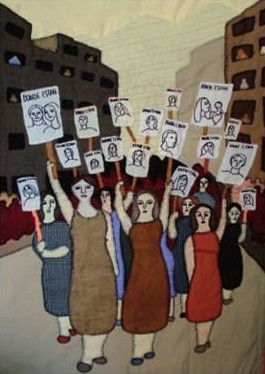
As collective creations, arpilleras also forged spaces of community and identity. Their making demanded courage, for each piece represented a defiance of the state’s regime of silence. Produced and exhibited clandestinely, these textiles served as acts of mutual care and shared grief, transforming domestic labor into political action (Plante, 2023). In this sense, arpilleristas subverted the limits imposed by the dictatorship, using art to render visible the silenced histories of state violence (see Figure 2).
Note. Victoria Díaz Caro. Isabel Morel de Letelier Collection, Museo de la Memoria y los Derechos Humanos. Retrieved from Piper et al., 2011, p. 256.
Despite repression, arpilleras circulated widely and gained international recognition as visual testimonies denouncing human rights violations (Adams, 2013; Pereda, 1977). Smuggled out of Chile through transnational solidarity networks, they reached Cuba, Spain, France, the Netherlands, Australia, the United States, Switzerland, Germany, England, Scotland, New Zealand, Canada, and Japan. Their trajectory reveals how grassroots artistic expression can transcend national borders, resonating with other women’s textile practices created amid conflict and state violence in contexts as varied as Afghanistan, Peru, Soweto, and Vietnam (Agosín, 2008; Rosentreter, 2020, p. 31).
The arpillera thus occupies a crucial place in the cultural memory of human rights in Chile. These textiles preserve the lived testimonies of repression and survival; as Francisco Pino Sáez observes, «Since the development of the peripheral neighbourhoods, arpillera artists wrote the unofficial history of their life experiences in their community through artistic expression» (2022, p. 89, own translation). Through cloth and thread, they wove counter-narratives that defied the dictatorship’s erasures. Today, arpilleras are embedded in Chile’s collective memory, displayed in both public and private collections as enduring reminders of the nation’s difficult past (Vinyes Albes, 2018, p. 346). Through their tactile repertoire, the arpilleras become what Taylor (2003) calls a performative archive: a living, embodied transmission of memory woven through material and gesture. Simultaneously, their circulation within and beyond Chile exemplifies Richard’s (1994) notion of the insubordination of signs, whereby art becomes a space of critical re-signification in times of political crisis.
During the transition to democracy, arpilleristas continued to narrate their stories and emotions through textiles, denouncing the persistent lack of recognition and support for their long struggles for truth, memory, justice, and reparation (Agosín, 1994, pp. 11–14).
Decades later, during the 2019 social outburst and the 2021 constituent debates, women once again assumed leading roles in community-based reflection and political participation. Textile art re-emerged as a collective practice of critique and imagination. Among these contemporary expressions are the Textile Artists of SASM, whose work engaged directly with the constitutional process, a phenomenon explored in the following section.
4 Chile’s Constitutional Processes
Chile’s recent constitutional processes cannot be understood solely as institutional events or procedural failures. They were also moments of intense affective mobilization, collective expectation, and political imagination, followed by frustration, fatigue, and disillusionment. Seen from feminist and critical approaches to power, these processes suggest that demands for social justice often go beyond what formal political institutions can contain. When institutional spaces close off or fail to respond, political meaning is not lost; it is taken up elsewhere, through cultural practices, embodied ways of coming together, and shared forms of storytelling that keep memory, connection, and solidarity alive beyond the state. We now turn to the recent constitutional processes (2021–2022 and 2023), both of which ended in the rejection of the proposed texts, leaving the 1980 Constitution in force.
The dictatorship not only represented a period of torture, death, and disappearance of Chileans (Comisión Nacional de Verdad y Reconciliación, 1991; Comisión Nacional sobre Prisión Política y Tortura, 2004), but the implementation of the first neoliberal laboratory in the world (Harvey, 2007, p. 14). This meant privatizing public goods, cutting public spending, and maximizing production and consumerism. The leading exponents of these economic transformations were the Chicago Boys, a group of Chilean economists who were trained at the University of Chicago (Valdés, 1995). For the Chicago Boys, the concept of liberty meant liberating the market from restrictions and privatizing health, pension, and education systems while setting the subsidiary role of the State. The 1980 Constitution was signed to confirm the dictatorship’s ideology (Fuentes, 2013). The Constitution was drafted by a commission designed for such matters, protecting private property rights and economic liberties, excluding social, political, and economic rights, and granting only the scarce protection of legal equality. Rights, benefits, and social services guaranteed by the State became the individual’s responsibility. Once democracy was recovered, this Constitution remained in force, making Chile one of the only democratic countries with its fundamental laws conceived during a dictatorship.
Although the original 1980 Constitution has undergone numerous amendments, the core elements of the political and economic model have remained mostly unchanged (Moulian, 1997). According to Fernando Atria (2013), the dictatorship established locks that would make it difficult for changes in the political and economic model, such as high quorums to modify some articles or the Constitution itself, the preventive control of the laws from the Constitutional Tribunal and the binomial electoral system.
President Michelle Bachelet initiated a constituent participatory process to modify the Constitution during her second mandate (2014–2018) due to public discontent with the existing one. The document Methodological Synthesis of the Participatory Process defines it as follows: «The Constituent Process open to citizens seeks to bring together citizens, social organisations, political and social forces, and representatives of academic, business, and cultural circles» (Consejo Ciudadano de Observadores, 2016, p. 1; authors’ translation). A synthesized text named Citizen Bases for the New Constitution was written using the deliberative convergence methodology. This proposal consecrated the Social State of Rights and amplified the catalogue of social rights, which has been a key element in changing the subsidiary State set out in the 1980 Constitution and its reforms. This constitutional reform was presented to the Senate by President Bachelet a few days before ending her mandate, but Sebastián Piñera’s government discarded it.
President Piñera continued his mandate amid discontent among social groups regarding the pension, education, and health systems, the perceived lack of connection between citizens and the «political class», and the lack of participation in decision-making, among other issues (Cuevas & Budrovich, 2020). Students mobilized in October 2019 to protest the rise in public transportation fees. Despite the emergency state of exception restrictions, more people joined the movement, expressing their discomfort towards the socioeconomic disparities accumulated over three decades under the neoliberal economic model and the 1980 Constitution (Rojas, 2022).
The social unrest continued with diverse manifestations, such as the performance by Las Tesis previously mentioned. Through an internationally known song, this group denounced the State’s complicity with violence towards women and the perpetuation of inequities (Vivaldi & Sepúlveda, 2021). The feminist complaints continued growing, demanding a feminist Constitution that included historically ignored or excluded rights, like caregiving rights, sexual and reproductive health, and violence-free life (Sepúlveda & Pinto, 2021). It also aimed to clarify the status of international human rights treaties in the legal system, the equal organization of the State, and greater participation of historically excluded groups and regions (Sepúlveda & Pinto, 2021). The organization of councils was fundamental to debate the basis for organizing the country, as well as an opportunity to dialogue and learn about the Constitution and the importance of the rights established in it. At the same time, during this period, the State violated human rights through police violence (Chile: A cuatro años del estallido social, 2023; Instituto Nacional de Derechos Humanos, 2020; Rojas, 2024).
Representatives from diverse political parties met during these mobilizations to sign the Social Peace and New Constitution Agreement on November 15, 2019. The agreement instituted a plebiscite in 2020 with two key questions: whether a new Constitution should be approved and whether the agency in charge should be elected in its entirety by the citizens (Constitutional Convention) or be mixed (Mixed Convention). The constituent organ would have nine months, extendable by three, to draft the new Constitution, which citizens would later validate or reject through an obligatory vote.
In March 2020, the COVID-19 pandemic forced the country into social confinement. Because of the high rates of contagion and mortality, the government implemented strict measures to safeguard the population, which limited in-person gatherings and slowed public demonstrations. Nevertheless, conversations, organizing efforts, and collective reflections continued through virtual platforms such as Zoom, allowing the constitutional debate to persist despite the restrictions. In October 2020, the national plebiscite was finally held, with a clear majority voting I Approve (78.27 %) and opting for an elected body to draft the new Constitution: The Constitutional Convention (78.99 %). The most important milestone for the demands of the feminist movements was the approval of parity in the constituent process, assuring the same number of male and female candidates and allowing for corrections to ensure equal representation in the election results. A Technical Commission set the basis for the new Constitution. In May 2021, 155 representatives of the Constitutional Convention were elected and began meeting in July 2021. The Convention created its rules and held annual sessions on themed commissions and plenaries. It also went to different localities further away from Santiago and opened a period for the presentation of popular norms initiatives to be discussed and eventually incorporated into the Constitution.
At the end of 2021, center-left presidential candidate Gabriel Boric, who supported a reform process, was elected president. The constitutional proposal was voted on September 4, 2022, resulting in its rejection by 62 % of the electorate. The rejection of the constitutional proposal can be traced to, among other things, voter confusion caused by the complexity of certain proposals and the perception that traditional political currents were excluded from the process (Larraín et al., 2023; Sajuria & Saffirio Palma, 2023).
Political parties negotiated, with some haste, the basis for a new constituent process to formulate a second Constitution proposal. Two new main organs were in charge of the new process: the Commission of Experts and the Constitutional Council. The Commission, composed of 24 members elected by Congress, delivered a draft that functioned as the basis for the Constitutional Council’s work. The Council was formed by 51 individuals chosen by universal suffrage. Contrary to the first process, the composition was more conservative. Popular norm initiatives were presented. The Council held sessions from June to November 2023. The plebiscite was voted on December 17th, 2023, resulting in a second rejection of the constitutional proposal with 56 % of the votes. Every political sector has suspended the constitutional debate, thus validating the 1980 Constitution.
Beyond its institutional path, Chile’s constituent process can also be understood as a struggle over belonging, recognition, and the possibility of being heard. The rejection of the constitutional proposals did not put an end to demands for social change; instead, those demands found other ways to circulate. As work on power and resistance has long shown, political conflict is not confined to formal institutions but takes shape in everyday practices, embodied encounters, and cultural expressions (Ahmed, 2004; Foucault, 1978; Taylor, 2003). From this perspective, the constitutional deadlock opened room for other forms of political imagination to develop—forms grounded in affect, memory, and collective creation. It is within this wider field of non-institutional political action that the textile practices of the SASM artists should be located.
5 The Textile Artists of the Salvador Allende Solidarity Museum
The textile artists of the SASM, which define themselves as an association of craftswomen and art workers (Textileras MSSA, 2023), was founded in 2018 at the SASM, located in the República neighborhood in Santiago, Chile. From their participation in a textile workshop in the museum, the participants formed the group with the explicit purpose of promoting the process of community textile creation as a means of expressing the social sentiment (Textileras MSSA, 2021, p. 11). In their work, this collective of artists mixes diverse textile techniques, using scraps and new materials to portray their own subjectivity on fabric. They convene weekly to engage in dialogues concerning issues pertinent to their political, economic, and gendered identities. According to Mayi Valdebenito, a member of the textile artists, their work cannot be reduced to aesthetic ends. Rather, their projects are:
Leftist political work. We are not affiliated with any political party, but we are left-leaning women. We have also defined ourselves as Allendista women who can contribute to discussions and reflections anywhere. We can take our work wherever we get invited and generate conversations. (Mayi, personal interview, March 2024)
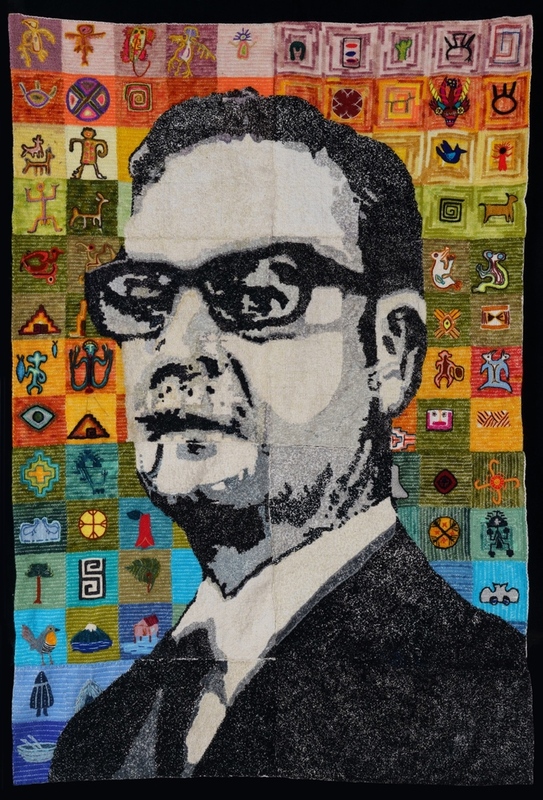
Furthermore, these gatherings served as platforms for the collaborative organization and execution of textile projects aimed at advancing dialogues within the broader societal context. Illustrative of these initiatives is a workshop they facilitated between October and November of 2023 titled For a Solidary Chile, comprising four sessions held at the Centro Cultural Gabriela Mistral. This textile workshop was open to the public, encouraging participation in dialogues concerning Salvador Allende’s 40 government measures. They also do commemorative pieces every year, like Indigenous New Year and Women’s International Day; and tributes, for example, to Margarita Ancacoy, a Chilean woman who was murdered on her way to work, and to former president Salvador Allende. They created a textile piece of Salvador Allende’s face in 2023, commemorating 50 years of the coup d’état. This piece was sent to the Organization of American States (OAS) in Washington, D.C., where it is was displayed at the front door (see Figure 3).
Note. Photograph sent directly via private correspondence by SASM, reproduced with authorization of Lorna Remmele. This textile was removed from the original display at OAS in 2026 without explanation.
For them, textiles serve as a means of expression, fostering community creation and resistance. Indeed, they term their actions as textile resistance, an act of rebellion against gender stereotypes depicting women as submissive and quiet, confined solely to domestic spaces (Textileras MSSA, 2021, p. 12). As noted earlier, these practices are rooted in forms of recognition that exceed formal rights and emerge through embodied gestures of care and mutual acknowledgment. In this sense, their textile work echoes other feminist artistic practices in Chile that turn creative action into a space for healing, collective strength, and political transformation.
In their textiles, we can see traits of the arpilleras made under the dictatorship. Marjorie Agosín describes:
As the women have accepted the task of telling by means of the arpilleras, their horizons have widened beyond their own personal sorrows to embrace those of other members of the group, the concerns of their neighborhoods, and finally they are thinking of the agony of the country. (1987, p. 86)
SASM textile artists continue the use of textile as a means to preserve collective memory and as a tool to challenge social injustices. On the fabric, they imprint their experiences and perspectives on what unfolds in the social realm, as well as their hopes for the future. Scholars emphasize that struggles for social transformation are not waged solely through ideas, rational calculations, or material resources but also through the embodied realm of emotions and affective expression (Goodwin et al., 2001; Jasper, 2011). Through practice, artistic creation becomes not only a way of preserving memory but also a means of generating knowledge and social transformation, enabling women to reimagine community life and confront injustice collectively.
6 The New Textile Constitution Analysis
This section analyses The New Textile Constitution, a collective project initiated and organized by the SASM textile artists in 2020, to examine the persistence of textile practices as a form of political action during Chile’s constituent process.
When more than two million Chileans took to the streets to protest in 2019, textile artists engaged in documenting and participating in the mobilization. They embroidered what they were witnessing in that moment, not just as a visual representation but also to encapsulate the shared feelings that filled the surroundings (Suil Aravena & Gatica Ramírez, 2021, p. 204). For example, Adria Haro Pérez identified six textile initiatives during the social mobilizations of 2019: Arpilleristas de Angachilla, La Zurcida, Brigada Brava, Conflict Textiles, Kath Textil, and Mil Agujas por la Dignidad (2023). Inspired by the dictatorship’s arpilleras, these initiatives created, documented, and promoted the work of textile pieces that showcased the political violence and social demands that developed in the protests. This way, textiles functioned as vehicles of memory since they «materialize a process of reflection around a historical moment in the country» (Haro Pérez, 2023, p. 68, authors’ translation).
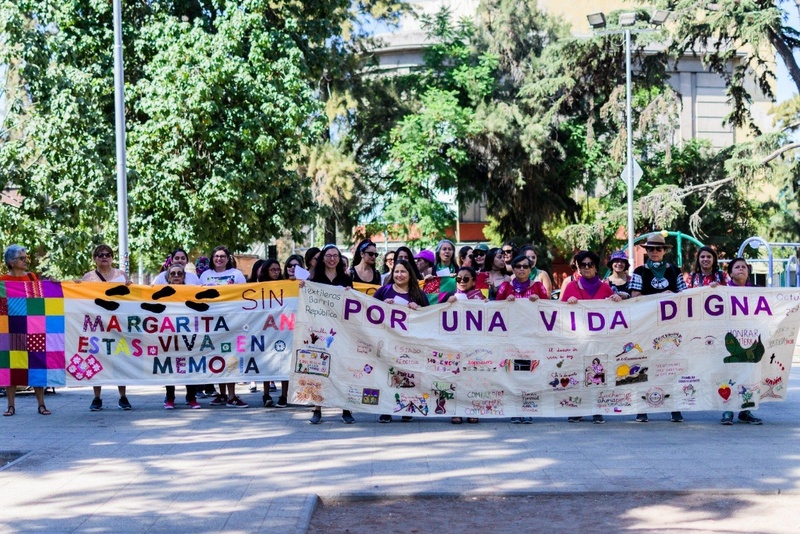
The SASM textile artists also took part in textile action during the social unrest. Every Friday, the textile artists facilitated a public space for collective encounters at Manuel Rodríguez Plaza in Santiago to discuss their worries and reflections. With a textile titled For a Dignified Life, neighbors of the República neighborhood manifested their feelings and their need to create change. This collective canvas, composed by each participant’s embroidery piece, has been displayed on different marches, like the International Women’s Day on March 8th, 2020 (Figure 4).
Note. Photograph sent directly via private correspondence by SASM, reproduced with authorization of Lorna Remmele.
After finishing that first project, their plan to link their work from the mobilizations to the constituent process was interrupted by the COVID-19 pandemic, when the government imposed a quarantine and prohibited in-person meetings to stop the spread of the virus. Nonetheless, the SASM textile artists continued their work through videoconferences in a workshop titled Dreaming a New Constitution, which resulted in the creation of The New Textile Constitution. For this collective, «The Constitution had to be written by the people, and not just by a few» (MSSA, 2020, 00:03:50, authors’ translation), emphasizing the importance of social participation in the constituent process. They manifested being in favour of a different Constitution: an alternative proposal that came from the heart and resonated with everyone; a Constitution that was a result of collective and inclusive work (MSSA, 2020).
6.1 Dialogue and Collective Creation Sessions
The Dreaming a New Constitution workshop consisted of dialogue and collective creation sessions. Participants met every Tuesday from September to December 2020 through Zoom, with the participation of around 60 people residing in Chile (and one in Argentina). Every session was directed by one or two different members of the textile artists, who prepared a presentation on a topic that the collective had previously decided to incorporate into the Textile Constitution. These were topics that surfaced strongly during the social unrest: education, culture, health, pensions, the environment, water, and housing (Figure 5). Every topic discussed was of personal interest to the textile artist presenting it. For example, one of them talked about the pension system because she was retired and part of an organization that criticized pension fund administrators (known as AFPs). Textile artists Mayi and Juani Valdebenito shared their experiences as formal and informal educators. Even during the dictatorship, and before becoming teachers, they taught literacy in a cultural center; therefore, they felt prepared to teach people with different levels of education.
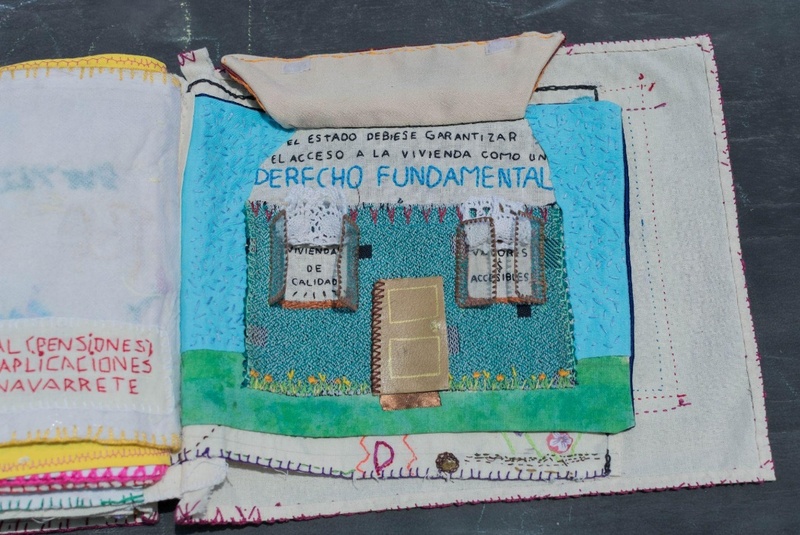
Note. Photograph sent directly via private correspondence by SASM, reproduced with authorization of Lorna Remmele.
After putting together each textile piece as one page of The New Textile Constitution (Figure 6), the textile book, divided into two volumes, was exhibited in the streets of the República neighborhood. The possibility of transporting the books allows them to be shared publicly, carrying The New Textile Constitution to activities in different places where the textile artists have participated. For example, they took the books to a street market, where they were invited to talk about the October 25th, 2020, plebiscite; they exhibited the books between fruit and vegetable stands, inviting people to vote. They also had the opportunity to show it to one of the constituents who visited the museum, and they sent the digital version to the Constitutional Convention’s library, making it part of the archive of the constituent process. Artistic creation, thus, not only records violence but also performs memory, allowing communities to re-embody histories that have been silenced by institutional narratives. In this sense, as Taylor (2003) posits, the repertoire operates as a living, embodied archive through which subaltern histories are enacted, not just remembered.
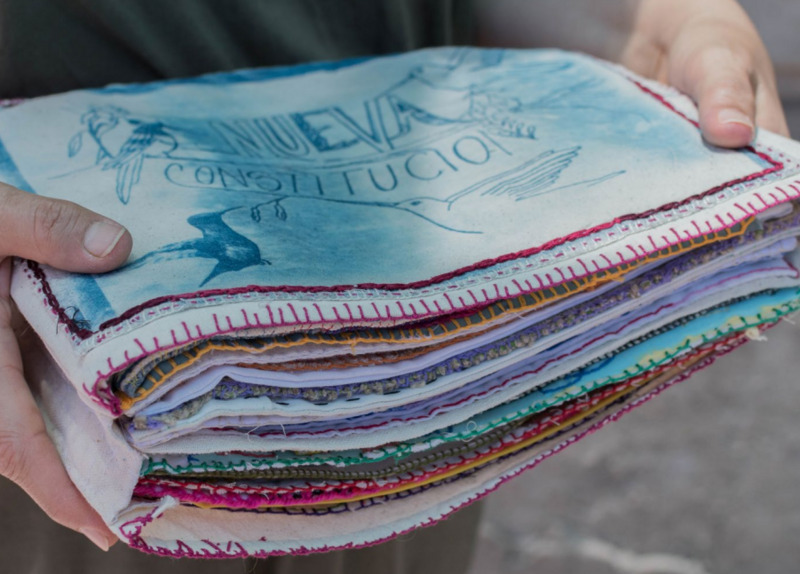
Note. Photograph sent directly via private correspondence by SASM, reproduced with authorization of Lorna Remmele.
The digital versions of both volumes and recordings of the dialogue and collective creation sessions are available on the SASM website.
6.2 Virtuality and Memory
During the pandemic, people had to abandon public spaces of dialogue and mobilization, adapting digital tools to continue their social activism. Itzel Cisneros Mondragón (2022) illustrates the importance of digital spaces of encounter in Latin America. Social projects had to be paused or even abandoned, and many violences were invisibilized, as they happened in the confinements of one’s house (Cisneros Mondragón, 2022). Thus, the need for collectivity was intensified and virtuality became the way to accomplish it.
Recordings of the virtual sessions of The New Textile Constitution are an example of this, as these sessions offered companionship in times of uncertainty for the constituent process and the health and well-being of people. Through virtual encounters, SASM textile artists connected with people inside and outside of Chile, turning this space into a shelter for reflection, encounters, companionship, and solidarity (Figure 7).
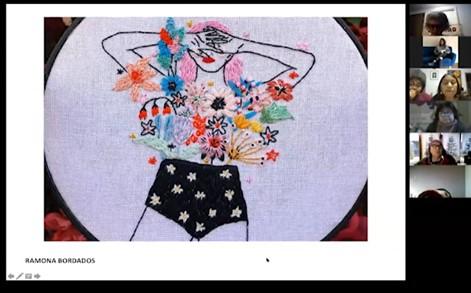
Note. Retrieved from Textileras Museo de la Solidaridad Salvador Allende (2020).
During the virtual sessions, participants discussed key themes for the new Constitution. They analyzed how the neoliberal principles embedded in the current Constitution restrict the role of the State in areas such as education, health, and housing, leaving these sectors largely to the free market. Furthermore, participants supported the inclusion of reproductive and animal rights as well as the recognition of indigenous groups and sexual dissidences.
Textile artists expressed it was difficult for participants to end the last session because they had been meeting every week throughout the lockdown. The workshop had become a space of accompaniment and mutual support during a period marked by uncertainty and isolation. A mother and a daughter who were physically distant could communicate through the meetings; other people joined outside of Chile, as they could not cross the border due to government restrictions. These moments of shared presence across screens reinforced the sense of solidarity that shaped the entire project, reminding the group that collective creation can hold people together even in the hardest of times.
7 Conclusions
The work of the textile artists of the Salvador Allende Solidarity Museum made visible forms of resistance that did not begin in parliament or expert committees but in informal places such as shared tables, needles, and conversations. Their New Textile Constitution is not only an artistic object: it is a collective gesture against the persistence of the 1980 Constitution and the exclusions produced by Chile’s neoliberal order. By stitching together memories of repression, everyday experiences of inequality, and desires for another kind of country, the textile artists keep open a space where the constitutional question remains alive, even when formal processes have been interrupted.
The workshop Dreaming a New Constitution was, above all, an affective and relational space. In the midst of pandemic isolation, participants met online to embroider anger, fear, grief, hope, and care. Textile work slowed down time and created a shared rhythm in which people could speak, listen, and imagine together. The resulting textile books condense those emotions: indignation over privatized social rights, concern over environmental destruction, and a strong wish for a constitution that recognizes social, reproductive, environmental, and collective rights. Resistance here is not only discursive; it is felt, handled, and passed from hand to hand.
Solidarity is another central thread. The Textileras are mostly women who organize themselves horizontally, teach one another, and open their projects to neighbors, social organizations, and international audiences. Their practice continues the legacy of the arpilleristas who, during the dictatorship, transformed domestic labor into public denunciation and mutual support. Today, their textile resistance challenges both authoritarian inheritances and gendered expectations that reduce textile work to private decoration. Each canvas is at once an individual statement and a fragment of a larger collective fabric that binds communities, generations, and struggles together.
Our research is grounded in a small set of encounters—one interview, participation in workshops and meetings, and careful reading of digital archives and textile volumes. It does not pretend to capture the whole field of community art and constitutional politics in Chile. What it does show is that, alongside failed institutional attempts at constitutional change, other, quieter processes were happening in other places of creation. In these spaces, resistance, affect, and solidarity are not abstract values but daily practices.
8 Author Contributions
Lucia Huerta: Conceptualization; formal analysis; investigation; methodology; writing – original draft; writing – review & editing.
Hugo Rojas: Conceptualization; formal analysis; investigation; methodology; writing – original draft; writing – review & editing.
Lieta Vivaldi: Conceptualization; formal analysis; investigation; methodology; writing – original draft; writing – review & editing.